Piranesi is a story to get lost in. It is a perfect book for this time of year: you can pick up on a drizzly Sunday morning, snuggled on the sofa with a cup of tea, and not put it down until tea time. It’s novel to be transported away by.
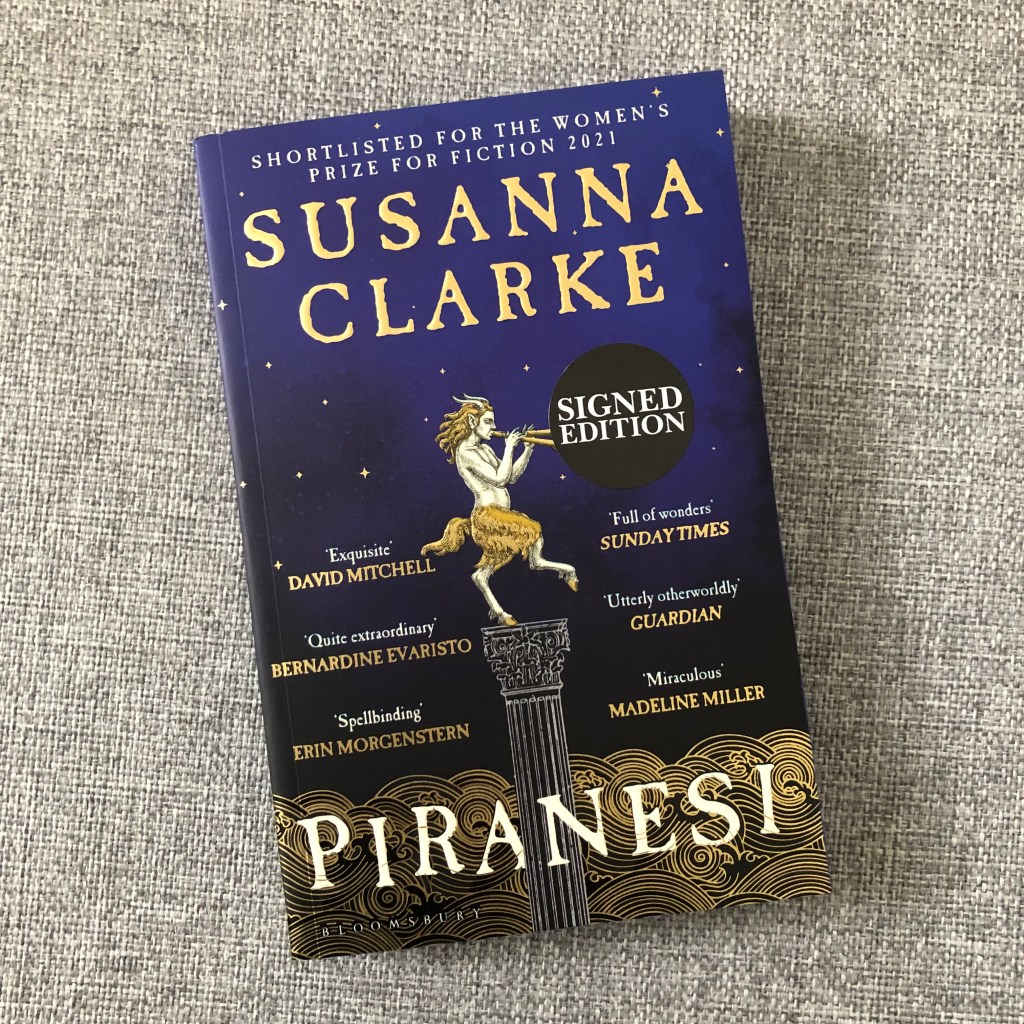
Piranesi lives in another World: one that is set up as a series of halls on different levels. The halls go in each direction of the compass and Piranesi, who is determined to “travel as much of the World as (he) can in (his) lifetime,” has gone as far as the “Nine-Hundred-and-Sixtieth Hall to the West, the Eight-Hundred-and-Ninetieth Hall to the North and the Seven-Hundred-and-Sixty-Eighth Hall to the South.” On the level above are the clouds and birds, and on the level below are the waves and tides. Piranesi lives in the World alone except for “the Other” who he sees on a weekly basis to discuss the finding of Knowledge. It is Piranesi’s belief that it his duty to document the halls and the vast array of statues to be found there: each statue different, each one with its own story.
In the Fifty-Second Western Hall I came upon a Wall ablaze with so much golden Light that the Statues appeared to be dissolving into it. From there I passed into a little Antechamber with few Windows, where it was cool and shadowy. I saw the Statue of a Woman holding out a wide, flat Dish so that a Bear Cub could drink from it.
Piranesi
That is until he starts to find evidence of someone else in the Halls. He can smell their perfume and sees the chalk markings they have left for themselves so they do not get lost. As Piranesi begins to learn more about the new person, he begins to re-read his earlier journals and starts to ask questions about himself and the Other. He knows that Piranesi is the name the Other has given him but cannot remember what his name was before that.
I read this book over two nights. Once I had got my head round the layout of the World with the different Halls and statues, I became immersed in it. The character is compelling and as the story unravels, and the danger Piranesi begins to find himself in increases, I was racing through to see what would happen next.
And you. Who are You? Who is it that I am writing for? Are You a traveller who has cheated Tides and crossed Broken Floors and Derelict stairs to reach these Halls? Or are You perhaps someone who inhabits my own Halls long after I am dead?
Piranesi
Since finishing the book I have looked up who the real Piranesi was and while I don’t think it is a spoiler in any way to know who he was (I don’t think it would have changed how much I enjoyed the book), if you don’t want to know please don’t read on but come back when you have read the book because this man was fascinating.
“I need to produce great ideas, and I believe that if I were commissioned to design a new universe, I would be mad enough to undertake it.”
Statement from Giovanni Battista Piranesi reported by one of his biographers – quote included in the Met Museum article, October 2003 (link to article below)
Giovanni Battista Piranesi was an artist in Venice in the 18th Century. He began as an apprentice working for an artist who created etchings of Rome and sold them as souvenirs for pilgrims, tourists and other visitors. Piranesi, however, always dreamed of being an architect and, taking inspiration from the ruins of Rome, he also created etchings of imaginary, incredibly complex, prisons. Looking at the etchings on a computer screen is probably useless in terms of getting a real feel for what they look like, but even from a screen you can see how wonderfully intricate but also frighteningly dark the prisons of Piranesi’s imagination are.
From reading about him it seems that he never gave up on the dream of being an architect. I found an article written by Jonathan Jones for The Guardian to be particularly interesting (I have put the link to the article below). According to Jones, Piranesi’s prints “were conceived as souvenirs – that is what Italy had come to by the 18th Century…. When Piranesi republished (the La Carceri series) in the extra-sinister edition of 1761… he gave himself an opening credit as “G Battista Piranesi, Venetian Architect.” The was as much a fantasy as the prisons themselves.”
Amongst the changing Venice, now on the start of its slow decline, Piranesi created his prints and got lost in his dreams.
Piranesi is more than half in love with his prisons. They are a place his imagination can wander, and at the same time an impossible place – the prints contain spatial paradoxes, including a staircase that exists on two planes simultaneously. It is a place without limits or contexts: Piranesi’s prison interiors have no outer walls, and each vista is cut off only by the frame of the image itself. The spaces are so big, so continuous, that they may not even be interiors; this may be a city that has grown into a world, where interior and exterior are no longer definable.
Jonathan Jones, The Guardian 6 November 2002 (link to article below)
I am so pleased that Susanna Clarke’s Piranesi encouraged me to research him and be introduced to the artist (architect) and his work: I have enjoyed reading about him. There is so much in the detail about Venice at that time, how artists created ‘art’ for souvenirs to make money, the changes in the city and getting lost in one’s own imagination.
Links to articles mentioned:
https://www.metmuseum.org/toah/hd/pira/hd_pira.htm
https://www.theguardian.com/culture/2002/nov/06/artsfeatures.highereducation
 Luggage & Scribble